

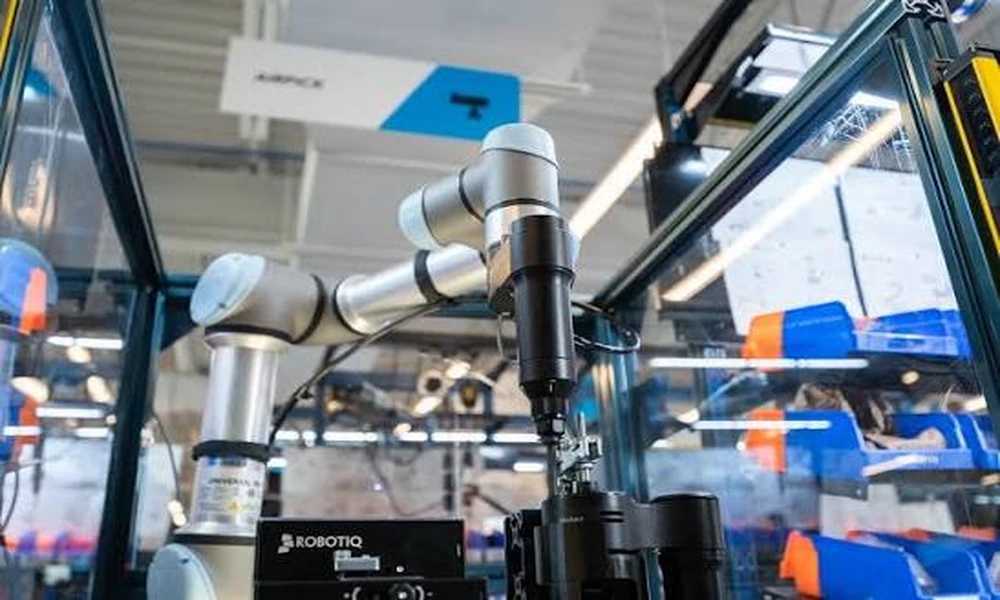
Screwdriving appears to be an ideal automation task. The movement is repetitive, the result can be defined by torque, and many manufacturing processes use the same fasteners hundreds or thousands of times. In practice, however, automated screwdriving involves more than placing an electric screwdriver on the end of a robot.
Fastener presentation, product positioning, tool access and process verification all influence reliability. A robotic cell can only deliver consistent results when these elements are considered together.
Torque is important, but it is not the whole process
Every fastening operation has a suitable tightening requirement. Too little torque may leave the joint loose, while excessive torque can damage threads, deform the product or break the screw.
A robotic tool therefore needs controlled fastening rather than simply high rotational force. The current Onrobot screwdriver, for example, provides programmable torque from 0.15 to 5 Nm and supports metric screw sizes from M1.6 to M6. Those figures describe the tool’s operating range, but the correct setting still depends on the joint, screw and material being assembled.
Manufacturers should therefore define the fastening specification before selecting the automation equipment.
Screw feeding can become the real bottleneck
The robot may position the screwdriver perfectly, but production stops if the next screw is not available in a predictable way. Automatic feeders can solve this problem in higher-volume applications, although different screw sizes and geometries may require changes to feeding equipment or setup.
A factory using several fasteners in one product should map those variants early in the project. Standardising screws where possible can simplify automation and reduce changeover requirements.
Feeding also needs to be tested with normal production fasteners. Coatings, damaged threads or dimensional variation can affect how consistently screws move through the system.
Product design influences robot access
Human assemblers are remarkably good at reaching awkward fastening points. They can tilt the tool, move a cable or change wrist position without consciously calculating the movement.
Robots need sufficient mechanical clearance. The screwdriver body, bit and robot wrist all have to reach the fastening position without colliding with the product or fixture.
OnRobot’s current Screwdriver includes a 55 mm integrated stroke and optional bit extensions, which demonstrates how tool geometry influences the design of an automated fastening station. For new products, considering robotic access during product design can make later automation much easier.
Process feedback reduces hidden failures
A major advantage of automated screwdriving is the possibility of monitoring the fastening operation. The system can potentially determine whether the screw was present and whether the programmed tightening sequence completed correctly.
OnRobot states that its current Screwdriver provides process results and checks intended to help identify common screw pickup and seating errors. In a production environment, this type of feedback is valuable because a robot otherwise has no intuitive way to recognise that a fastener was missing or incorrectly inserted.
Monitoring should still be integrated into a broader quality strategy. A successful torque result does not necessarily confirm that every aspect of the assembled product is correct.
A good first project should be predictable
Robotic screwdriving works best when products arrive in repeatable positions and the number of fastener variants is limited. Accessible screw locations and stable joint design also simplify integration.
Production volume matters too. Automating a handful of screws per day may not make economic sense unless quality, traceability or ergonomics create another strong reason for the investment.
At higher volumes, the benefits are easier to identify. Consistent fastening, reduced repetitive work and measurable process results can all add value. The key is to treat screwdriving as a complete assembly process, not simply as a powered tool attached to a robot.
