

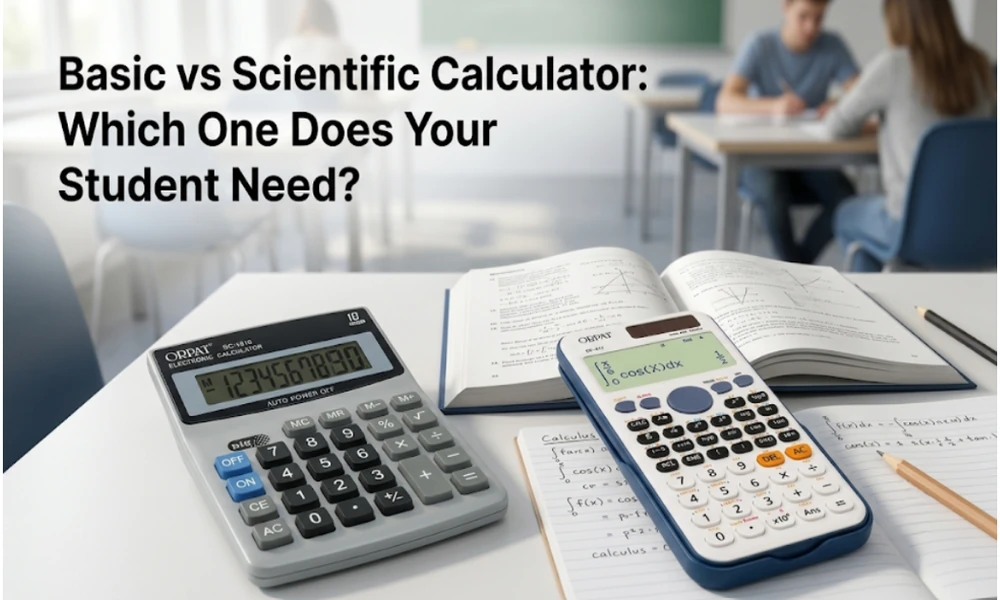
It might not seem like a huge choice, but the calculator a student uses can impact them differently depending on their grade level, the subjects they are taking, and what they need to achieve academically. Everyday math can be done with a simple basic calculator. But a scientific calculator has other functions to help with more complex math problems.
Knowing the difference between the two can help parents and students choose a calculator that meets their current needs without paying for features they may never use.
What Is a Simple Calculator?
A simple basic calculator has been programmed for simple math operations such as addition, subtraction, multiplication, and division. Many models also have functions for percentages, decimals, and square roots.
When the curriculum is just basic arithmetic, a basic calculator can do the job for younger students. It is also good for everyday calculations at home or at school.
For beginners, a simple calculator is easier to understand because it is less complicated, with fewer buttons and functions. This also decreases the possibility of you pressing an unknown function by accident while learning basic calculations.
What Is a Scientific Calculator?
A scientific calculator is helpful in doing advanced mathematical calculations. In addition to standard arithmetic, it can have functions for trigonometry, logarithms, exponents, fractions, powers, and other computations.
Students working on algebra, geometry, trigonometry, physics, and higher-level maths may benefit from these additional functions.
A scientific calculator can also save the amount of manual calculation needed for complex problems. Students should understand the mathematical concepts behind the calculations and not rely on the calculator to produce an answer.
Difference Between Basic Calculator and Scientific Calculator
The main difference is the types of functions provided.
A basic calculator is generally enough for basic calculations, whereas a scientific calculator is meant for more complex mathematical calculations.
For example, a student doing simple multiplication might only need a basic calculator. A student working on trig equations or logarithms would usually require functions that aren’t found on a basic model.
Students should take their syllabus into account before choosing between a Basic and Scientific Calculator. It’s not because one has more functions than the other.
Which Calculator Should a Student Use?
The right choice depends very much on the level of study and subject matter of the student.
Primary School Pupil
If the student’s work involves simple arithmetic and calculators are permitted, a basic calculator may suffice. Maybe students would be better served to learn how to do calculations by hand before going to electronic help at this point.
For Students in Middle School
Curriculum might change the requirements. If you are doing basic calculations, a basic calculator will still do the job. Students starting with more advanced maths may require more functions.
High School and College Students
If you are studying advanced science or maths subjects, you will probably need a scientific calculator. Subjects may involve trigonometry, algebra, statistics or scientific calculations that may require functions beyond basic arithmetic.
Before buying, students should check the calculator rules of their school or exam board. Some exams only allow certain types of calculators, or prohibit certain functions.
What to Think About Before You Buy
Functions: Make sure the calculator can perform the operations required in the student’s syllabus.
Display: A clear display can help make calculations easier to read and review.
Ease of use. Students should be able to find functions they use a lot.
Durability: A calculator that you use regularly should be able to survive normal academic use.
Power: Determine whether the model operates on batteries, solar power, or both.
Test compatibility: Before purchasing a calculator for academic use, check the examination guidelines.
Daily or academic needs can differ, and brands like Orpat and others provide calculators to suit them, giving students options to choose based on the functions they need.
Basic vs. Scientific Calculator: Which Should You Choose?
The choice between a basic calculator and a scientific one isn’t necessarily about which calculator has more features. It’s about selecting a calculator that fits the student’s present academic needs.
For basic arithmetic, a simple calculator can be a useful choice, but when students begin to branch out into more advanced maths and science topics, a scientific calculator is more appropriate.
When choosing a Basic vs Scientific Calculator, take into account the student’s curriculum, future academic needs, and examination rules. By selecting based on actual needs, you can ensure that the calculator remains useful without complicating the learning process unnecessarily.
